
A healthy, high-performing lawn is one of the most valuable features of any Victorian home. It cools your outdoor environment, adds to your property’s appeal and provides a functional surface for your family to enjoy across every season. But even the best-maintained lawns can come under pressure from pests, and knowing what to look for and how to respond is essential to protecting your investment in turf.
Victoria’s climate creates conditions that support a range of lawn pests, particularly through the warmer months when soil temperatures rise and insect activity increases. Most pest issues are entirely manageable when detected early, but left unchecked they can cause significant damage to turf health, density and appearance. Here’s what to watch for and how to keep your lawn performing at its best.
African Black Beetle
African Black Beetle is one of the most prevalent and damaging lawn pests across Victoria. The adult beetles are shiny, dark brown to black, and measure around 12 to 15 millimetres in length. You may spot them moving across paths or driveways on warm evenings, but it is the larvae that cause the real damage to your lawn.
The larvae, commonly referred to as curl grubs, are creamy-white, C-shaped grubs that live in the soil and feed directly on the root system of your turf. By severing the roots, they disconnect the grass from its ability to access water and nutrients, which means the damage often shows up as patches of lawn that look drought-stressed even when irrigation has been consistent. In more advanced infestations, the turf can be peeled back from the soil like a loose carpet because the root system has been almost entirely consumed.
One of the most reliable early indicators of curl grub activity is increased bird interest in your lawn. If you notice magpies, crows or other birds digging persistently into the turf, they are very likely feeding on grubs just beneath the surface.
The larval stage is most active through late summer and into autumn, and this is the optimal window for treatment. A targeted lawn grub insecticide applied according to the label directions and watered thoroughly into the soil will bring an active infestation under control. For long-term protection, applying a preventative grub treatment in early summer before larvae become established is one of the most effective strategies available. It is a relatively small input that can prevent significant turf damage and costly repair later in the season.
Lawn Armyworm
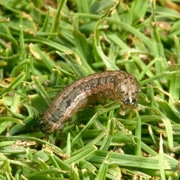
Armyworm is one of the more dramatic lawn pests you are likely to encounter in Victoria. The damage often appears to happen overnight, with large sections of lawn stripped back to bare stems or soil level in what seems like a single event. The caterpillars responsible are the larvae of a nondescript brown moth, and they tend to appear in large numbers after periods of warm, humid weather, particularly through late spring and summer.
The caterpillars themselves are smooth-bodied, grow to around 30 to 40 millimetres in length, and are identifiable by three pale stripes running along their back and sides. They feed on the leaf blade of the grass rather than the root system, and because they move in large groups, they can strip an area bare in a remarkably short period. Armyworm are predominantly night feeders, sheltering in the thatch layer or just below the soil surface during daylight hours, which is why the damage often seems to appear from nowhere.
A simple detection method is to pour a bucket of soapy water over a suspect area of lawn near the edge of the damage. If armyworm are present, the soapy water brings them to the surface within about ten minutes. This is best done at dusk when the caterpillars are becoming active.
Treatment involves applying a liquid insecticide to the leaf surface during the late afternoon, just before the caterpillars emerge to feed. Mowing the lawn beforehand helps ensure good contact between the product and the leaf, keeping in mind that repeat applications may be necessary over the following weeks if moth activity has been high and new eggs continue to hatch.
The positive aspect of armyworm damage is that it is largely cosmetic. Because the caterpillars feed on the leaf rather than the root, a lawn with a healthy root system will typically recover well once the pest has been eliminated. A deep watering followed by a light fertiliser application will support the turf through its recovery phase. Your backyard cricket pitch will be back in action in no time!
Scarab Beetle Grubs Including Argentine Scarab
While African Black Beetle receives the most attention, Victoria is home to several other scarab beetle species whose larvae behave in much the same way. The Argentine Scarab has become increasingly common across parts of Melbourne and regional Victoria in recent years and is worth being aware of.
Like African Black Beetle grubs, Argentine Scarab larvae are C-shaped curl grubs that live in the soil and feed on the root system of your turf. The symptoms mirror those of African Black Beetle infestation: browning patches that do not respond to watering, spongy or soft areas underfoot, turf that lifts easily from the soil, and elevated bird activity across the lawn. The key difference is that Argentine Scarab grubs tend to be slightly smaller and can sometimes appear in greater numbers, which means the damage can escalate rapidly if not addressed.
Treatment follows the same approach as for African Black Beetle larvae. A quality grub insecticide applied during the active larval stage and watered into the soil profile will reduce populations effectively. Maintaining a healthy, well-fed lawn also improves recovery, as turf with a strong root system is better equipped to tolerate and bounce back from root feeding damage.
Couch Mite
Couch Mite is a pest specific to couch grass varieties, and it can be a persistent challenge for Victorian homeowners who grow couch lawns. The mites themselves are microscopic and invisible to the naked eye, but the damage they produce is unmistakable. Infested grass develops a distinctive bunched or distorted growth pattern at the nodes, creating rosette-like tufts commonly described as a “witches’ broom” appearance that stands out clearly from the surrounding healthy turf.
Couch mite is one of the more difficult lawn pests to manage because chemical control options available to home gardeners are limited. The most effective defence is maintaining a vigorous, well-nourished lawn that can tolerate and outgrow minor infestations. Regular fertilising, consistent mowing and proper irrigation all contribute to a turf surface that is more resilient under mite pressure.
In cases where the infestation is severe and the affected areas are not recovering, removing and replacing the damaged turf may be the most practical solution. If couch mite is a recurring issue in your area, it is also worth considering whether an alternative turf variety might be a better long-term fit for your property. StrathAyr varieties such as Sir Walter DNA Certified Buffalo and TifTuf Hybrid Bermuda are not susceptible to couch mite and can deliver strong performance across a wide range of Victorian conditions.
Billbug
Billbug is a lesser-known pest in Victoria, but it can cause meaningful damage, particularly in buffalo and kikuyu lawns. The adults are small, dark weevils with a distinctive elongated snout, and they are easy to overlook because of their size. Small but mighty! It is the larvae, small creamy-white grubs that feed inside the grass stems and crown, that are responsible for the visible damage.
Billbug damage often mimics the appearance of drought stress or nutrient deficiency, which means it frequently goes undiagnosed for an extended period. A useful diagnostic technique is to pull on a brown or dying stem of grass. If it breaks away easily at the crown and you can see a fine, sawdust-like material called frass inside the stem, billbug is the likely cause.
Because the larvae feed inside the plant tissue rather than on the root system in the soil, they can be more difficult to reach with conventional surface-applied treatments. Systemic insecticides that are absorbed into the plant tend to be more effective, and timing the application to target young larvae before they have caused extensive internal damage is important for achieving good results.
Two-Spotted Mite
Also known as red spider mite, the two-spotted mite becomes particularly problematic during hot, dry conditions. These tiny mites feed by piercing individual grass cells and extracting the contents, which gives the lawn a silvery, bleached or washed-out appearance. In heavy infestations, fine webbing may be visible across the turf surface, especially in areas that are sheltered from wind.
Two-spotted mite thrives when turf is under stress from heat and insufficient moisture, which makes it a pest that is as much about management as it is about treatment. One of the most effective control strategies is also one of the simplest: maintaining a consistent, deep watering schedule during the warmer months. Turf that is well hydrated and not under drought stress is significantly less attractive to mite populations and far more resilient if they do appear.
If mite pressure is high and the lawn is showing clear symptoms, a targeted miticide can help reduce numbers. However, improving the growing conditions for your turf should always be the first priority, as this addresses the underlying vulnerability rather than just the symptom.
When to Seek Professional Advice
Most lawn pest issues can be managed effectively at home with the right products, correct application and timely action. However, if you are dealing with persistent problems that do not respond to treatment, widespread damage across a large area, or you are uncertain about the cause of your lawn’s decline, it is worth consulting a turf professional or your local garden centre for a more targeted diagnosis.
Misidentifying the pest or applying the wrong product can delay effective treatment and allow the problem to worsen. Getting an accurate diagnosis early ensures you are directing your time and investment toward a solution that will actually work. If you need a hand with this, the StrathAyr team are never more than an email or phone call away!
Maintaining a High-Performing Lawn Year-Round
The most effective long-term defence against lawn pests is a healthy, well-maintained turf surface. Regular mowing at the correct height, deep and infrequent watering, a consistent seasonal fertiliser program and prompt attention to early warning signs all contribute to a lawn that is more resilient under pest pressure and recovers faster when issues do arise. Prevention is always better than cure!
Victoria’s climate means pest activity is a normal part of lawn ownership, particularly through the warmer months. But with the right knowledge and a proactive approach to maintenance, there is no reason your lawn cannot deliver strong, consistent performance across every season.
At StrathAyr, we are committed to helping Victorian homeowners get the most from their turf. Whether you need guidance on variety selection, maintenance practices or managing a pest issue, our team is here to help.