
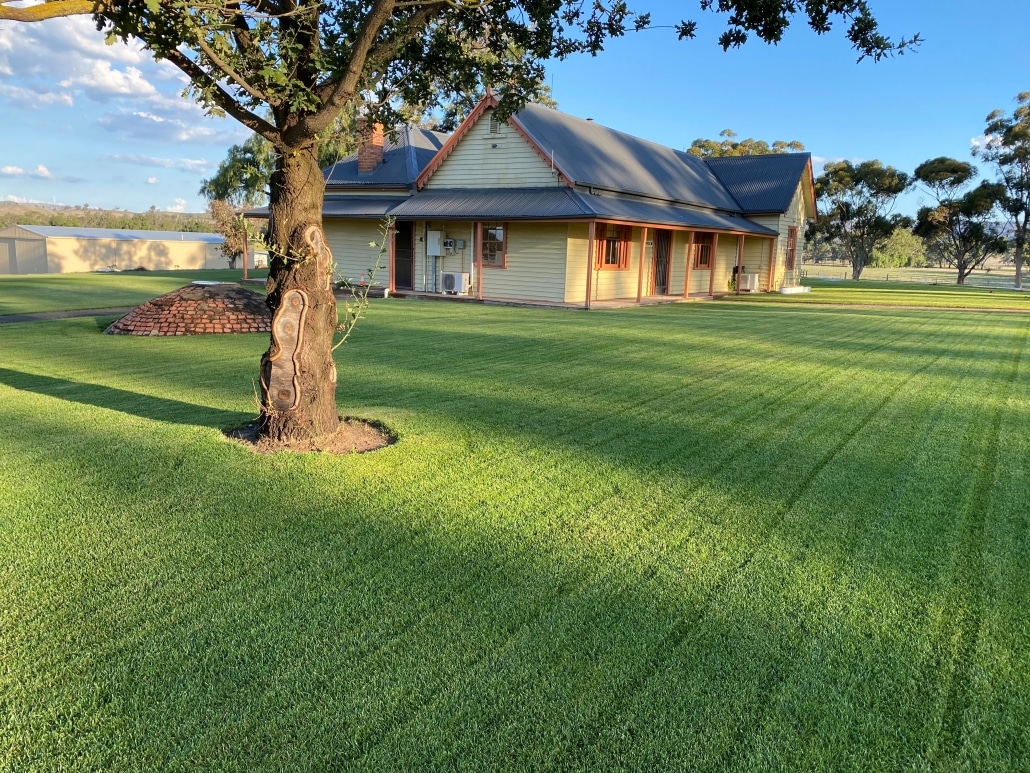
Creating safe, inviting green spaces is at the heart of every council’s responsibility to its community, and something StrathAyr have spent over 50 years assisting with. While ovals and roadsides often enjoy full sun exposure, many parks, playgrounds, shared-use community spaces and urban reserves present a different challenge altogether: shade.
Mature tree canopies, newly established boulevard plantings, playground shade sails and surrounding infrastructure can all significantly reduce the sunlight reaching a turf surface. Without careful planning, shaded turf areas can thin out, become muddy, or fail altogether, leading to increased maintenance costs and public dissatisfaction.
Here at StrathAyr, we have developed a practical guide for councils on successfully managing turf performance in shaded environments.
Understanding the Type of Shade You’re Dealing With
Not all shade is equal, and understanding the difference is essential when planning turf management strategies.
Light or filtered shade refers to the dappled sunlight that passes through open tree canopies, while moderate shade typically means an area is receiving around three to four hours of direct sunlight per day. Heavy shade describes conditions where less than two to three hours of direct sunlight reaches the turf surface.
In public parks, the most common scenario is tree-generated filtered shade that gradually intensifies as trees mature. Seasonal variation also plays an important role, particularly in Victoria, where winter sun angles can dramatically reduce available light across southern-facing spaces.
Conducting seasonal shade mapping helps asset managers identify high-risk areas before turf decline occurs, allowing maintenance crews to respond proactively rather than reactively.
Selecting the Right Turf Variety for Shaded Environments
Variety selection is the single biggest factor in achieving long-term success in shaded public spaces, and a skill the StrathAyr team have down to a fine art.
For parks and community areas where shade is a consistent challenge, a shade-tolerant warm-season variety such as Sir Walter DNA Certified Buffalo performs strongly. It tolerates as little as two to three hours of direct sunlight daily and maintains density under filtered canopy cover, making it a reliable choice for areas beneath established trees.
For mixed-use council parks with higher foot traffic but partial sun exposure, TifTuf Hybrid Bermuda can perform well in areas receiving at least four to five hours of sun. It offers superior wear tolerance while still handling moderate shade better than traditional couch varieties, making it well-suited to parks that see heavy community use during daylight hours. Perfect for those parts of the park where you often see a game of kick-to-kick being played!
Where councils are managing shaded sites in cooler climate zones, or where year-round green coverage is a priority, RTF Tall Fescue is an excellent option worth considering. As a cool-season grass, RTF performs well with as little as three hours of direct sun per day and maintains active growth through the cooler months, when warm-season varieties slow down or go dormant. Its unique rhizomatous root system also gives it self-repairing properties, meaning it can recover from wear and thinning without the need for constant overseeding or patching. For shaded community spaces that experience moderate to high foot traffic across all seasons, RTF Tall Fescue delivers a combination of shade tolerance, year-round colour and self-repair capability that few other varieties can match.
Councils should avoid fine couch types in heavily shaded parkland unless sunlight thresholds are comfortably met, as these varieties require higher light intensity to maintain density and will typically thin out quickly under canopy cover.
Increasing Light Penetration Through Canopy Management
Healthy trees and healthy turf must coexist, and proactive arboricultural management is critical to achieving that balance.
Selective pruning to improve light filtration, lifting lower branches to increase air circulation, and thinning dense canopy sections where it is safe and appropriate to do so can all make a meaningful difference to turf performance beneath established trees.
Improving airflow through canopy management also reduces prolonged leaf wetness on the turf surface, which in turn limits fungal disease pressure. This is a particularly common issue in shaded public lawns where moisture can linger well into the day, creating ideal conditions for disease to establish.
Adjusting Irrigation Practices for Shaded Zones
Shaded turf areas typically require less water than full sun areas, and overwatering is one of the most common causes of turf decline in parks under tree cover.
Turf growing in shade evaporates moisture more slowly, retains soil moisture for longer, and is naturally more prone to fungal disease when kept too wet. Councils should consider zoning irrigation separately for shaded sections rather than applying a uniform watering schedule across variable conditions. This allows asset managers to reduce water inputs where shade and canopy cover are already helping to conserve soil moisture.
Deep, infrequent watering encourages stronger root systems and improves overall turf resilience, particularly in areas where tree roots are competing for the same moisture and nutrients in the soil profile.
Modifying Mowing Heights and Frequency
In shaded environments, turf benefits from a slightly different mowing approach than what might be standard practice in full sun areas.
Maintaining slightly higher mowing heights allows the plant to maximise its leaf surface area for photosynthesis, which is especially important when available sunlight is already limited. Reducing mowing frequency during cooler months also helps prevent unnecessary stress, and ensuring blades remain sharp minimises damage to the leaf tissue with every cut.
For Buffalo varieties growing in filtered shade conditions, maintaining a height of 35 to 50 millimetres rather than cutting low helps retain both density and vigour over the longer term. RTF Tall Fescue benefits from a similar mowing height range, and its upright growth habit responds well to regular mowing during warmer months while naturally slowing its growth through winter.
Managing Traffic in Shaded Community Spaces
Playgrounds, picnic shelters and dog parks often concentrate foot traffic in the very zones where shade is most prevalent. Reduced sunlight combined with consistent wear accelerates turf thinning and can lead to bare, muddy patches that become both unsightly and unsafe.
Strategies to mitigate this include installing stepping stone pathways through high-traffic areas, using mulched tree rings to prevent compaction around trunks, rotating event layouts in community parks to distribute wear more evenly, and reinforcing high-use zones with temporary barriers during wet months when turf is at its most vulnerable.
Where traffic is unavoidable and turf must perform under pressure, selecting a durable, self-repairing variety becomes even more critical. Both Sir Walter DNA Certified Buffalo and RTF Tall Fescue offer strong recovery characteristics that help shaded turf bounce back from wear without constant intervention.
Fertiliser and Soil Health Management
Shaded turf does not require heavy nitrogen inputs. In fact, excess fertiliser in low-light areas can promote soft, weak growth that is more susceptible to disease and less able to withstand foot traffic.
A more effective approach focuses on balanced nutrition programs, with slow-release fertilisers applied in spring and early autumn to support steady, sustainable growth. Conducting regular soil testing helps guide fertiliser inputs and ensures resources are being directed where they are genuinely needed. Monitoring thatch levels and aerating compacted soils on an annual basis also supports healthy soil structure, improving drainage, oxygen exchange and root strength in the areas where turf is working hardest to survive.
Considering Alternative Treatments for Extreme Shade
In areas receiving less than two hours of direct sunlight daily, turf may not be the most sustainable or cost-effective ground cover option, regardless of variety selection.
In these situations, councils may find better long-term asset performance by converting extreme shade zones to garden beds, installing shade-tolerant groundcovers, expanding mulched tree zones, or using permeable hardscape solutions in high-traffic areas. Strategic redesign of these spaces often delivers a more practical outcome than repeated turf replacement cycles that consume maintenance budgets without delivering lasting results.
Planning for Long-Term Performance
As urban tree canopies mature and councils continue to invest in cooling and greening initiatives, shaded public spaces will only continue to expand. Selecting appropriate turf varieties, adjusting maintenance regimes and proactively managing canopy cover ensures community parks remain safe, green and functional across every season.
At StrathAyr, we work alongside councils to support specification decisions and long-term turf performance strategies for public open space projects. Whether you’re evaluating shade-tolerant varieties for an upcoming project or reviewing maintenance approaches across existing assets, our team is always available for consultation.
From a site inspection to variety specification, if you’d like support reviewing shade-prone sites within your municipality, get in touch with the team today.